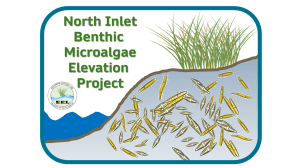
The Benthic Microalgal Subsidy in Estuarine Ecosystems
James L. Pinckney, Erik Smith, Eilea Knotts, John Kupfer, Craig Plante
National Science Foundation
Biological Oceanography
(grant # OCE 2241830)
2023 – 2026
Estuaries are nurseries that are critical habitat for many commercially and recreationally important species. The base of the food web in these systems is supplied by microalgal primary production in both the water column (phytoplankton) and the sediments (benthic microalgae). This project focuses on quantifying the contribution of benthic microalgae to total ecosystem primary production in the North Inlet Estuary, SC. Benthic microalgal production estimates along an elevational gradient (low to high tide region) are then used to assess responses to the impending sea level rise. The results have implications for wetlands valuation, carbon credits, trophodynamics, and carbon storage in estuarine ecosystems. This research is transformative in that it provides the first ever comprehensive measures of intertidal, ecosystem-level benthic microalgal contributions to total net primary production to evaluate the ecological importance of BMA for estuarine ecosystem processes and functions. The research results will likely restructure our understanding and current paradigms of energy flow and cycling processes in estuaries.
Our current understanding of ecosystem net primary production in southeastern estuaries is missing a fundamental component that may, in fact, provide as much as a third of the fixed C fueling the high biomass of upper trophic levels. The concept of a major benthic microalgal-based subsidy contradicts the traditional views that phytoplankton and detritus-based food webs are the only energy sources for most southeastern estuaries. This project quantitatively determines the relative BMA contribution by characterizing the spatiotemporal variability in BMA NPP to estimate the annual ecosystem-level contribution to total system NPP. The primary objective is the measurement of estuarine intertidal BMA NPP, biomass, community composition, and relevant environmental variables (nutrients, grain size, porosity, etc.) along fixed transects that span the intertidal elevational gradient from mean low water to mean high water and incorporate these results in a GIS DEM to calculate ecosystem-level BMA NPP. Furthermore, the GIS model predicts shifts in the magnitude and spatial distribution of BMA NPP resulting from various sea-level rise scenarios.
USC Institute for Clean Water and Healthy Ecosystems
T. Richardson (PI), J. Pinckney, C. Benitez-Nelson, L. Pennington-Gray, S. Richardson,
M. Myrick, M. Hodgson, N. Vitzilaios
Funded by USC Vice President for Research
2023 – 2027
Clean water is vital to the health and well-being of all South Carolinians. Population growth and changes in land use especially near lakes, rivers, and the coastal ocean have resulted in increased inputs of contaminants, resulting in negative impacts on our aquatic ecosystems. Deforestation, construction of new communities, and industrialization contribute to inflows of contaminants from sewage outputs or non-point source run-off from land. These include nutrients, polyfluorinated alkyl substances (PFAS), 6ppd-quinone, pesticides, pharmaceuticals, herbicides, viruses, coliform bacteria, and parasites. Toxin-producing or ecosystem-disruptive algal blooms, fish kills, death of pets and livestock, and even human health issues can result, as can unpalatable drinking water and reduced water quality for recreational purposes. In a state where tourism alone adds ~$29 billion annually to the economy (South Carolina Dept. of Parks, Recreation, and Tourism, 2022), protection of our aquatic resources is vital.
The mission of the Institute for Clean Water is to catalyze and coordinate USC research efforts in scientific and socioeconomic aspects of water quality with a view towards solving current and emerging challenges to sustained sources of clean water. Our research efforts target water for consumption (drinking water) and for recreational use (boating, fishing, swimming). Our aims are 1) to identify the major water quality issues facing South Carolinians and how they vary regionally, seasonally, and interannually, 2) to develop biological and chemical sensors for improved and more efficient water quality monitoring, and 3) to identify and quantify new and emerging threats to water quality, and their potential biological impacts, with a view towards developing better mitigation and management strategies with stakeholders, and 4) to probe deeper into the social and economic dimensions of water quality with research to quantify the importance of clean water to SC residents and visitors, the thresholds that define willingness to tolerate poor water quality, and the behaviors that result in response to scientific evidence and perception of risk. These behaviors may include geographical shifts in population density, reductions in visits to lakes, rivers, or oceans by residents and visitors, and accompanying losses in tourism or recreationist revenues.
Our research questions and approach are designed in part to generate preliminary data for a National Science Foundation (NSF) Science and Technology Center (STC) proposal. Critical to future funding successes will be strengthening ties with SC-Department of Health and Environmental Control’s (SC-DHEC’s) Bureau of Water (primarily responsible for water quality monitoring in the state) and with other relevant entities to develop a broad-scale, coordinated water quality monitoring program. Institute funding will also help us develop better ties with industries interested in development of water-quality-related biotechnology. We will develop innovative and easily deployable methods for water quality monitoring, including detection and quantification of cyanobacterial blooms, with future work focused on emerging contaminants like PFAS and 6ppd- quinone. Further, we will tightly integrate sociological and scientific research on issues related to water quality such that one informs the other. The layering of geographically distributed social science data onto water quality observations will help predict population responses to future environmental change such as those resulting from drought, flooding, rising temperatures, and other physical changes.

Phytoplankton at Lake Murray Study (PALMS)
Weekly Sampling Program Run by Undergraduate Research Assistants in the Estuarine Ecology Lab
PALMS is an ongoing weekly to bi-weekly sampling program (started in 2021) to measure water quality and phytoplankton dynamics in Lake Murray, SC. This program is administered by the undergraduate research assistants in the Estuarine Ecology Lab. Students travel to the sampling site and perform a variety of measurements including profiles of water column temperature, conductivity, pH, dissolved oxygen, phycoerythrin fluorescence, chlorophyll a fluorescence, and irradiance. Water samples are returned to the lab for measurements of nutrients, photopigments (for phytoplankton community composition), Pulse Amplitude Modulated (PAM) fluorometry, and microscopy. This project has served as the focal point for numerous senior theses and independent studies projects.
 Estuarine Ecology lab